Rubescent
Menu

Rubescent / Public-sector systems design

Rubescent works with public agencies, school districts, civic organizations, and mission-driven nonprofits to design the systems that help talent stay, grow, and move. VIVID™ is one framework within that broader practice.

The framework

VIVID™: A Proprietary Theory of Talent Infrastructure

Most HR problems are not performance problems. They are infrastructure problems. VIVID™ names what most organizations leave invisible: the institutional conditions that determine whether talent becomes visible, whether it gets supported, and whether it can move forward.

Proprietary theory25 years of practiceDesigned for equity

01 / The visual model

See the system around the talent.

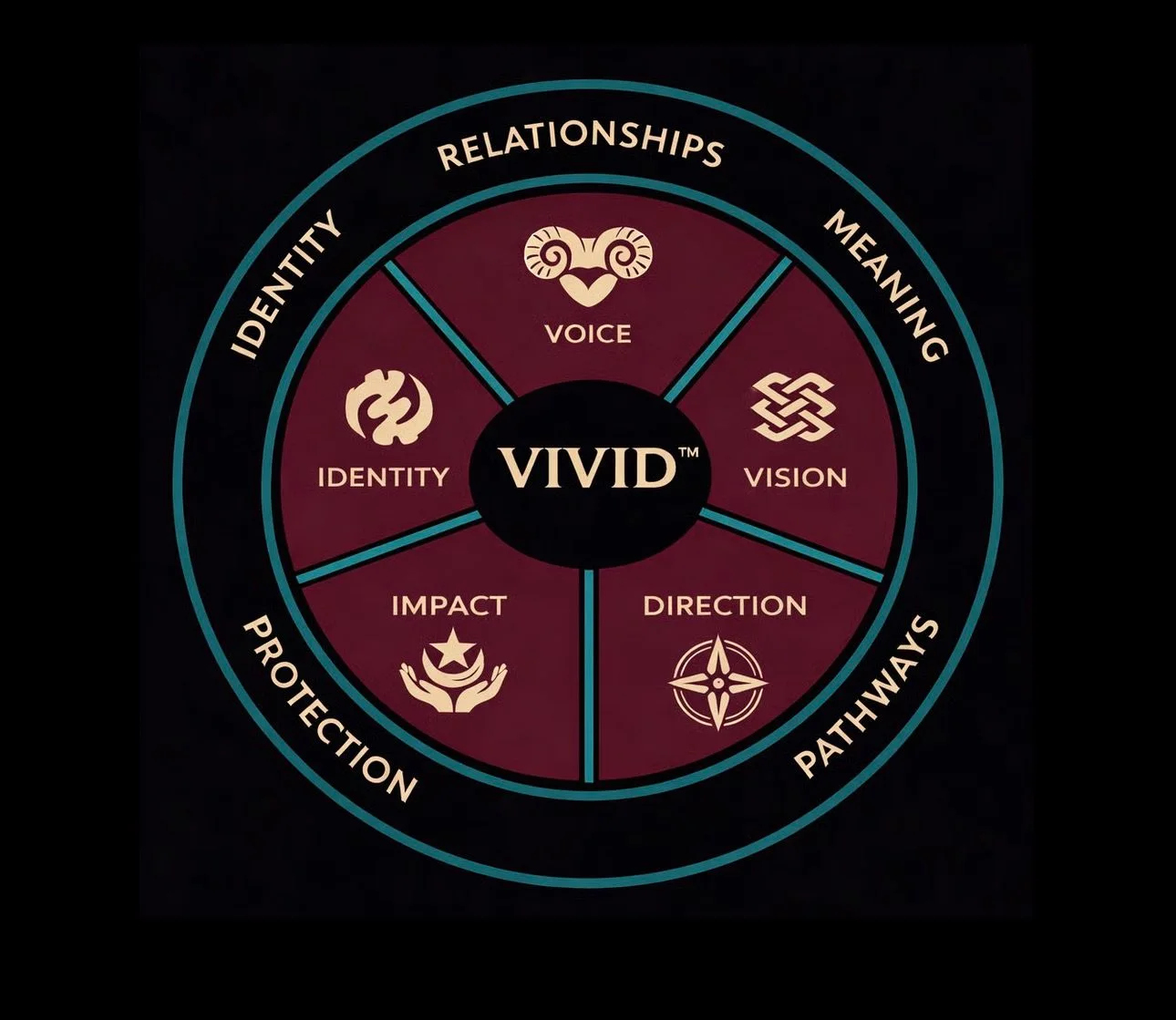
The VIVID™ wheel holds leadership experience and institutional conditions in the same view. The framework asks what people bring, what the environment makes possible, and where the relationship between the two needs attention.

VIVID™ wheel diagram labeled VIVID™, Voice, Identity, Vision, Impact, Direction, Relationships, Meaning, Pathways, and Protection.
Five leadership anchors held within the conditions that help talent move.

02 / Where talent stalls

The Three Patterns That Stall Talent

01

Signal Substitution

Organizations lean on credentials, degrees, and years of experience as proxy for capability. The result: hiring the wrong people, developing the wrong people, missing people who could move the organization forward. Capability gets misaligned with opportunity. Succession planning becomes reactive rather than predictive.

02

Identity Distortion

Organizations misread how people show up, treating communication style, work rhythm, relationship patterns, and cultural knowledge as problems to solve rather than assets to build with. The people most likely to experience identity distortion are the people from communities whose talent the organization most needs. They protect themselves by stepping back.

03

Pathway Fragmentation

Recognition is not development. Organizations identify high-potential people and then lose them at every transition. Each new role brings a new leader, a new sponsor, a new explanation of how things work. Talent gets stuck. Succession planning fails because you built successors in silos, not in ecosystems.

03 / The architecture

The Five Infrastructure Domains

VIVID™ operates across five interconnected domains:

Illustrative conceptual scene of talent moving through institutional infrastructure, with labels for access points, pathways, navigation, opportunity, relational conditions, cultural top-soil, and foundation systems
An illustrative representation of talent moving through infrastructure, not an assessment result or a separate VIVID™ model.

01

Relational Networks

Networks that actually mentor, not just manage. Infrastructure where people are genuinely seen and supported.

02

Navigational Systems

Systems that make pathways visible and legible. People understand how to get to the next role and who will support them there.

03

Opportunity Experiences

Experiences where people can be seen doing the work. Where capability is demonstrated, not just claimed.

04

Institutional Structures

Structures aligned to development, not just vacancy-filling. Where development is built into how work gets done.

05

Measurement Systems

Systems that track capability, not just credentials. Where organizations actually know who is capable and why.

04 / The outcome

The Three Shifts That Occur

When these five domains work together, three things shift:

Signal Clarity

Your organization actually knows who is capable and why. Hiring becomes predictive. Development becomes targeted. Succession planning becomes accurate.

Identity Affirmation

People show up as themselves, not as edited versions of themselves. The organization sees what they bring. Development builds on strength.

Pathway Coherence

Talent moves because the pathways are designed to move it. Mentorship is structure, not luck. Transitions are supported. People understand how to get to the next role.

05 / Tools, by conversation

Tools for Making Talent Visible

Rubescent uses these tools within its broader talent-infrastructure framework for public-sector, municipal, K-12, and nonprofit organizations.

01 / Diagnostic

VIVID™ Leadership Diagnostic

VIVID™ examines the five leadership anchors, Voice, Identity, Vision, Impact, and Direction, alongside the environmental conditions that support or constrain them.

It is a leadership diagnostic within the broader Rubescent talent-infrastructure framework, used to name what is visible, what is blocked, and what the system needs. It is not a self-scored assessment.

Request a VIVID™ conversation ↗

02 / Advisory tool

VIVID™ Infrastructure Match

The Infrastructure Match places the leader profile and the environment side by side to show where strengths are supported, where the environment is failing the leader, and what to do next.

Rubescent uses this as an advisory conversation within its talent-infrastructure work. Start with the context around the leader, not an automated score.

Request a VIVID™ conversation ↗

VIVID™ makes visible what organizations leave invisible.

Request a conversation